Biloxi: 228-435-3000 | Ocean Springs: 228-872-6000 | Hattiesburg: 601-583-5000
Biloxi Longshore Lawyer: The Man Who Pulls His Living From Back Bay Deserves A Lawyer Who Has Actually Stood In Front Of A Federal Judge
You work the water. You have worked it your whole life. If you need a Biloxi longshore lawyer, you need one who has actually stood in front of a federal Administrative Law Judge — not a TV lawyer whose secretary has never been inside a U.S. Department of Labor hearing room.
Right now, as you read this, the carrier’s adjuster already has a file with your name on it. He has already written a preliminary note about how the injury happened. He has already calculated the number he wants to pay you. He works longshore claims every single day. He knows the system the way you know that harbor. And the TV lawyer whose billboard you passed on Highway 90? He has never been inside a U.S. Department of Labor hearing room. Not one time has he stood before any federal Administrative Law Judge out of the New Orleans district. Not once has he put a Longshore and Harbor Workers’ Compensation Act claim on file for anyone in Harrison County. What he can do is answer your call, give you a file number, hand you to a case manager, and collect a fee while the adjuster runs the clock on you.
That is not bad luck. That is the business model.
Why Harrison County Longshore Workers Need A Biloxi Longshore Lawyer Who Knows The Federal System
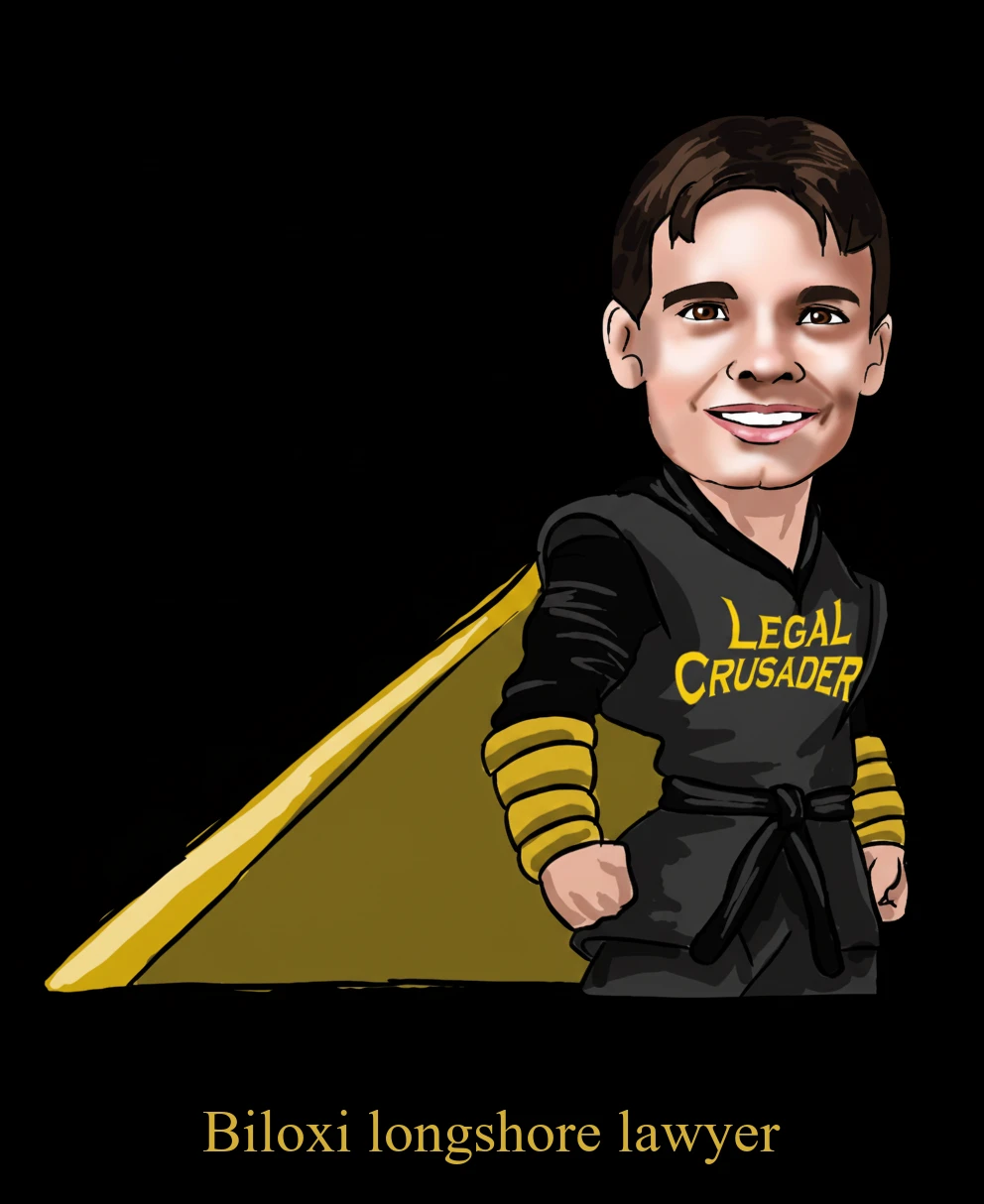
I am Jay Foster. The Legal Crusader. I have been practicing law on the Mississippi Gulf Coast for decades. I walk into the Harrison County courthouse. The federal longshore system is familiar ground to me. I work inside the U.S. Department of Labor and the Longshore division of its Office of Workers Compensation Programs, the part that runs LHWCA claims. I am on a first-name basis with the Administrative Law Judges across the New Orleans district who rule on Mississippi longshore cases. And I am the only lawyer in Mississippi who GUARANTEES in writing, before we start, that you will put more money in your pocket than I do. Every case. No exceptions.
The LHWCA is not Mississippi workers’ compensation. It is a federal system. It has its own rules, its own deadlines, its own hearing process. You notify your employer within thirty days. You file a formal claim within one year. If the carrier disputes your claim, it goes to a federal ALJ. The carrier’s lawyers handle LHWCA cases every week. They know the judges. They know the procedures. They know which arguments work and which ones do not. When your lawyer walks into that hearing room for the first time and introduces himself to the judge, the carrier’s lawyer is already three steps ahead. That is the gap that costs you money.
You can pull up every Mississippi lawyer’s Bar license status through the state Bar’s public database before you hire anyone. The TV lawyer advertising on Gulf Coast television does not have a Mississippi Bar license. He cannot walk into any Mississippi courthouse. He certainly cannot stand in front of a federal ALJ on your behalf in a longshore hearing. What he can do is take your call, assign you a case manager, and wait for a settlement that pays him first.
Every Longshore Claim I Handle For Biloxi Workers
Dock and waterfront injuries. Slips, falls, crush injuries, and equipment failures on piers, wharves, and loading areas at the Small Craft Harbor and Back Bay facilities. If the injury happened on a covered maritime situs, the LHWCA likely applies.
Commercial fishing and shrimping vessel injuries. Biloxi has run shrimp boats and oyster vessels for over a century. Workers injured loading, unloading, or working aboard covered vessels may have LHWCA coverage depending on the specific facts of their employment.
Shipyard commuter injuries. Many Harrison County residents drive to Gulf Ship, Bollinger Gulfport Shipbuilding on Bayou Bernard, Gulf Coast Shipyard Group, or the Halter Marine facilities and get hurt on the job. Your LHWCA claim follows the injury and the employer, not just the city where you live.
Crane, forklift, and equipment injuries. Heavy equipment failures on covered maritime sites produce some of the most serious longshore injuries. Crush injuries, amputations, and traumatic brain injuries all require experienced handling from the first notice of injury forward.
Occupational disease and hearing loss. Longshore workers exposed to industrial noise, toxic substances, and hazardous conditions over years of employment may develop conditions covered under the LHWCA. These claims are time-sensitive and require early action.
Death claims. If a covered worker dies from a work injury, the LHWCA provides survivor benefits. These claims require immediate attention to protect the family’s rights.
Where A Biloxi Longshore Lawyer’s Clients Actually Work: The Back Bay And Small Craft Harbor
The Biloxi Small Craft Harbor sits at 679 Beach Boulevard, adjacent to the Hard Rock Casino, in the heart of old Biloxi. The harbor operates four facilities with nearly five hundred slips. Charter fishermen run out of there every morning. Commercial shrimpers work Back Bay and the Mississippi Sound. Dock workers load and unload. The harbor funds itself entirely from slip rentals and building leases. It is a working waterfront, not a tourist attraction, and the workers on it face real hazards every single day.
Back Bay of Biloxi runs inland from the Sound, bordered by Highway 90 bridge on the west and the long bridge to Ocean Springs on the east. Dozens of small craft facilities, repair operations, and waterfront businesses operate along that water. The Covacevich family ran a boatyard on Back Bay from 1896, building everything from schooners to World War II minesweepers. The tradition of maritime work in Biloxi runs deep. So does the carrier’s knowledge of how to manage the claims that come out of it.
If you were hurt on Back Bay, at the Small Craft Harbor, at any Biloxi pier or wharf or dock, or if you were injured working at one of the Gulfport or Pascagoula shipyards and you live in Biloxi, you need a lawyer who understands the LHWCA at the federal level. Not someone who handles car wrecks and farms out the federal maritime work.
What The TV Lawyer Does Not Tell You About Longshore Claims
He does not tell you that the case manager he assigns to your file is a secretary with a fancier title. No law degree. No Bar license. No authority to give you legal advice. No standing to appear in any proceeding. She handles your file the way a clerk handles paperwork. She is not fighting for you. She is moving files.
He does not tell you that the carrier will send you to their doctor. That doctor is not your doctor. He works for the carrier. His job is to find as little injury as possible, as fast as possible, so the carrier can cap its exposure. When he says you have reached maximum medical improvement, the carrier uses that opinion to stop your wage replacement benefits. Your own treating physician may disagree entirely. The carrier does not care. They have a piece of paper from their doctor.
He does not tell you that there are deadlines that can kill your claim. Thirty days to notify your employer. One year to file a formal compensation order request. Miss either one without the right documentation, and the carrier has a procedural argument that can wipe out years of potential benefits. The TV lawyer’s intake team will not catch this because they are running volume, not cases.
He does not tell you that he cannot try your case. He has no Mississippi Bar license. He cannot file a lawsuit in this state. He cannot argue your case in front of a federal ALJ in the New Orleans district. When the carrier says no, he has to find someone local to do the actual work, and that someone may not know your case the way you need them to.
Think about it this way. If you needed surgery on your shoulder, would you let a doctor licensed only in Florida perform the operation? Would you trust a Florida medical license to get you through a Mississippi operating room? The carrier’s lawyers are not going to stop the procedure. They are going to let it happen and watch you lose.
Harrison County Drivers Have Rules Too And So Do Longshore Employers
Every driver on Highway 90 through Biloxi has rules to follow. Speed limits. Lane requirements. No phone in hand. Those rules exist because when someone ignores them, people get hurt. The same is true on every dock, every pier, every loading area in this harbor. Employers have federal safety obligations. Carriers have obligations to pay legitimate claims at the correct compensation rate. Those obligations do not disappear because the carrier has a team of lawyers and you do not.
Civil courts and federal hearing rooms exist for one reason: to hold people and companies accountable when they refuse to follow the rules. The carrier is counting on you not knowing your rights. They are counting on you accepting the first number they offer. They are counting on the lawyer you hired not being able to walk into that hearing room and make them answer for what they owe you. I can walk into that room. I have been doing it for decades.
What The Carrier Does The Moment You Report Your Injury
The carrier assigns an adjuster before you finish filling out the incident report. That adjuster requests a recorded statement. He asks about prior injuries. He asks about your medical history. He asks questions designed to build a file that minimizes your claim. He is friendly. He tells you the company wants to take care of you. He means they want to take care of the claim at the lowest possible cost.
The carrier sends you to their IME doctor. IME is short for Independent Medical Examination. Of all the words a longshore insurance company uses, “independent” is the biggest lie. That doctor is paid by the carrier. He performs examinations for the carrier on a regular basis. He knows what the carrier needs from his report. His opinions tend to favor the carrier. That is not a coincidence. That is a business relationship.
The carrier tracks your social media. If you post a photo from a family gathering showing you standing and smiling, that photo goes in your file. If you check in at a restaurant, that goes in your file. The carrier is building a case against you from the moment your injury is reported. You need someone building a case for you with the same urgency.
The federal Longshore division at the U.S. Department of Labor administers the LHWCA. The benefit formula is set by federal law. Weekly pay under the Act is figured on your average weekly wage, at a rate of two-thirds, with national floors and ceilings that get revised each year. The carrier knows exactly what they owe. They are looking for reasons to pay less. I am looking for reasons to make them pay every dollar the law requires.
Three Mistakes Biloxi Longshore Workers Make That Cost Them Everything
First mistake: giving a recorded statement without talking to a lawyer first. The adjuster will call you within hours of the injury report. Expect a request to put your voice on tape. Just routine, is what he will say. For you, nothing about it is routine. Every word you say in that recorded statement can be used to limit your claim. A description of your pain level, a statement about how the accident happened, an offhand comment about returning to work, all of it goes in the file and can be used against you at a hearing. Think of the recording as the opening play in a series of moves meant to shut your file for the smallest figure the insurance company can get. You are not required to participate in it. Most workers do because no one ever told them otherwise.
Second mistake: seeing only the carrier’s doctor. You have the right to seek treatment from your own physician. The carrier’s doctor serves the carrier’s interests. Your own doctor serves yours. The LHWCA has specific rules about authorized treating physicians and how disputes between medical opinions are resolved. Understanding those rules before you start treatment protects your claim. Not knowing them lets the carrier pick the doctor who decides your future.
Third mistake: waiting too long to act. Evidence disappears. Security footage gets overwritten. Witnesses move. Incident reports get filed in ways that favor the employer. The carrier’s file is growing from day one. The longer you wait to put a lawyer on your side of that file, the wider the gap becomes between what the carrier knows and what you do.
The Foster Fair Fee Guarantee: The One Promise No TV Lawyer Will Ever Match
Before we start, I guarantee in writing that you will put more money in your pocket than I do. Not after the case. Before we begin. In writing. Every client. Every case. No exceptions.
A TV lawyer was so concerned about Biloxi waterfront workers seeing this guarantee in writing that he ran to the Mississippi Bar with a complaint trying to suppress it. The Bar dismissed it. Think about that move on its own terms. A licensed Mississippi lawyer treated a written consumer-protection promise as something to file an ethics complaint about. Not match. Not compete with. Suppress. The complaint reads less like a legal filing and more like a competitor admitting on the record that the only thing standing between him and your case is the comparison information he is trying to keep out of your hands. The Bar’s dismissal is the end of the legal question. The fact that a complaint like that ever got filed is the beginning of a different question entirely about whose interests that lawyer is actually working for.
You can read the full details of the Foster Fair Fee Guarantee before you call me. Read it. Then call the TV lawyer and ask him to match it in writing. Listen to what he says.
▼ Get Your FREE Book Right Now ▼
Fill Out The Form Below And I Will Send It Immediately
The $5,000.00 Double Dare: Put Your Money Where Your Billboard Is
I will pay you $2,500.00 cash if the TV lawyer whose face is on the billboard personally handles your longshore case from the first call to the final check. Every phone call. Every hearing appearance. Every filing. Personally. Second payment, another $2,500.00 from me, if that very TV lawyer personally argues your Biloxi longshore case before a federal Administrative Law Judge working the New Orleans docket for the U.S. Department of Labor.
Five thousand dollars. Paid in cash. If the face on the billboard does the actual work.
Nobody has ever collected.
Biloxi: The Water Has Always Come First Here
Biloxi has been a maritime city since before it was a city at all. Shrimp boats and oyster vessels worked these waters when the rest of the Gulf Coast was still figuring out what it wanted to be. The seafood industry built Biloxi’s identity. Hundreds of shrimping and oyster vessels still operate from Back Bay and the Sound in season. The Small Craft Harbor was rebuilt after Hurricane Katrina destroyed the original building, reopening in 2010, because this community does not quit on the water.
Keesler Air Force Base sits inside the Biloxi city limits. The base employs thousands of military personnel and contractors. Defense contractors in the region extend the maritime and military workforce across Harrison County. The workers who build and maintain the systems that protect this country deserve a lawyer who will protect them when the carrier decides their injury is not worth paying for.
The casinos along Highway 90 put Biloxi on national maps. But the people who keep this city working are on Back Bay at five in the morning, not on the casino floor. Those are my clients. Those are the people this practice was built for.
You can reach Harrison County resources and the Harrison County Circuit Court through the county’s official site. For longshore claims, the governing federal authority is the federal Longshore division at the U.S. Department of Labor. For medical treatment after a Back Bay injury, Memorial Hospital at Gulfport serves Harrison County maritime workers throughout the region.
Frequently Asked Questions From Biloxi Longshore Workers
I Got Hurt On A Charter Fishing Boat At The Small Craft Harbor. Does The LHWCA Cover Me?
It depends on the specific facts. The LHWCA covers workers who meet both a status test and a situs test. Status means your work is maritime in nature, loading, unloading, shipbuilding, repair, or work integral to those functions. Situs means the injury occurred on navigable waters or an adjoining area like a dock, pier, wharf, or terminal. Charter fishing workers and commercial fishing crew members sometimes fall under the Jones Act instead of the LHWCA depending on their employment relationship and the nature of the vessel. This is not a question to guess at. The wrong determination at the front end of the case can extinguish significant rights you did not know you had.
The Carrier’s Adjuster Told Me My Claim Is Worth A Certain Amount. How Do I Know If That Is Right?
You do not. That number was calculated by someone whose job is to minimize what the carrier pays. Wage replacement under the LHWCA equals two-thirds of your average weekly wage, held between federal minimum and maximum figures that shift every year. Permanent impairment has scheduled benefits under the Act for specific body parts. With a serious Biloxi injury, the space between the insurance company’s offer and what the law actually demands can run enormous. The adjuster’s number is the start of the negotiation, not the end of it, and most injured workers never realize that until after they have signed.
Can I Sue The Shipyard Or Vessel Owner If The Equipment Failure That Hurt Me Was Their Fault?
Sometimes. The LHWCA generally bars direct lawsuits against your employer. But if a third party, a vessel owner who is not your employer, an equipment manufacturer, or another contractor, contributed to your injury, you may have a Section 905(b) claim or a separate negligence claim against that third party. These claims run alongside your LHWCA benefits and can significantly increase your total recovery. Identifying third-party liability requires someone who knows both the federal longshore system and Mississippi civil litigation. Spotting who else is liable is exactly the work the call center secretary has never done.
How Long Does A Biloxi Longshore Claim Take?
A claim nobody contests can wrap up fairly fast once treatment ends and the impairment rating is in. When a federal ALJ has to hold a hearing, expect a longer road, frequently a year or more between filing and decision. Appeals to the Benefits Review Board add additional time. What costs you the most time is delay at the beginning. A week lost to missing paperwork, unsaved evidence and no formal notice is a week handed to the insurance company. Workers who collect what their claims are truly worth tend to have a lawyer on the file in week one, not month three, and that gap shows in the final number.
I Live In Biloxi But I Drive To Pascagoula To Work At Ingalls Or Bollinger. Where Do I File My Longshore Claim?
The LHWCA claim is filed with the U.S. Department of Labor based on the location of injury and the employer’s coverage, not your home address. Your home city does not determine jurisdiction. What matters is whether you are a covered employee working at a covered maritime situs. If you are working at Ingalls or Bollinger Mississippi Shipbuilding in Pascagoula, your claim is filed through the federal system and may be heard in the New Orleans district. My office handles those cases regardless of where the worker lives. Biloxi address, Pascagoula injury, federal claim.
How Much Does It Cost To Hire You For A Biloxi Longshore Case?
Longshore cases are handled on contingency under the LHWCA’s fee structure. You pay nothing upfront. Attorney fees in LHWCA cases are subject to approval by the Department of Labor or the ALJ. Before we begin, I will give you the Foster Fair Fee Guarantee in writing: you put more money in your pocket than I do. That guarantee is in writing before we start. No TV lawyer will match it because they cannot afford to.
You built your life working this water. The carrier is counting on you not knowing what that work is worth under federal law. They are counting on the lawyer you hire being unable to argue your case when it counts. They are counting on the gap between what they offer and what you accept being money they keep.
I have been closing that gap for Biloxi workers for decades. My office is in Ocean Springs, nine miles from the Biloxi Small Craft Harbor. I know this community. I know this coastline. I know what it costs a family when the waterfront worker comes home hurt and the carrier starts running its playbook against him.
The consultation is free. The carrier’s clock has been running since the morning of your injury. When you have decided you are done letting them run it without anyone on your side of the file, my number is 228-872-6000.
P.S. The Foster Fair Fee Guarantee is in writing before we start. Read it here. Then ask the TV lawyer to match it. The silence after that question is the most expensive sound in the room.
P.P.S. If you or someone you know was hurt working the water near Gulfport, see the Gulfport longshore lawyer page. If the injury happened near Pascagoula or you work at Ingalls or Bollinger Mississippi Shipbuilding, see the Pascagoula longshore lawyer page.
▼ Get Your FREE Book Right Now ▼
Fill Out The Form Below And I Will Send It Immediately