Biloxi: 228-435-3000 | Ocean Springs: 228-872-6000 | Hattiesburg: 601-583-5000
D’Iberville Longshore Lawyer: The Man Who Crosses Back Bay Every Morning To Build Ships Deserves More Than A Case Manager Who Has Never Seen The Yard
Every morning you cross that bridge. Back Bay is below you. The water is gray or gold depending on the season, and you are already thinking about the shift ahead. You are driving to Gulf Ship on Seaway Road in Gulfport, or to Bollinger on Bayou Bernard, or all the way out to Ingalls or Bollinger Mississippi Shipbuilding in Pascagoula. You do this because you are good at what you do and you built a life doing it. D’Iberville is home. The shipyard is where the paycheck comes from.
Then the injury happens. And the carrier opens a file with your name on it before the shift supervisor finishes writing the incident report. The carrier’s adjuster calls you. He is friendly. He asks questions. He records the answers. He schedules you with the carrier’s doctor. Every step of that process is designed by people who handle LHWCA claims for a living, built to minimize what they pay you. And the TV lawyer whose billboard you passed on I-110 on the way home that day isn’t a real D’Iberville Longshore lawyer? He has never been inside a U.S. Department of Labor longshore hearing room. He has never argued a case in front of a federal Administrative Law Judge in the New Orleans district. He took your call, gave you a case number, and handed your file to a case manager who has never set foot inside any shipyard you have ever worked in.
That gap between what the carrier owes and what they actually pay you is money they keep. Every day you are represented by someone who cannot go to the hearing is a day the carrier wins.
Why D’Iberville Shipyard Workers Cannot Use A TV Lawyer Who Cannot Enter The Fight
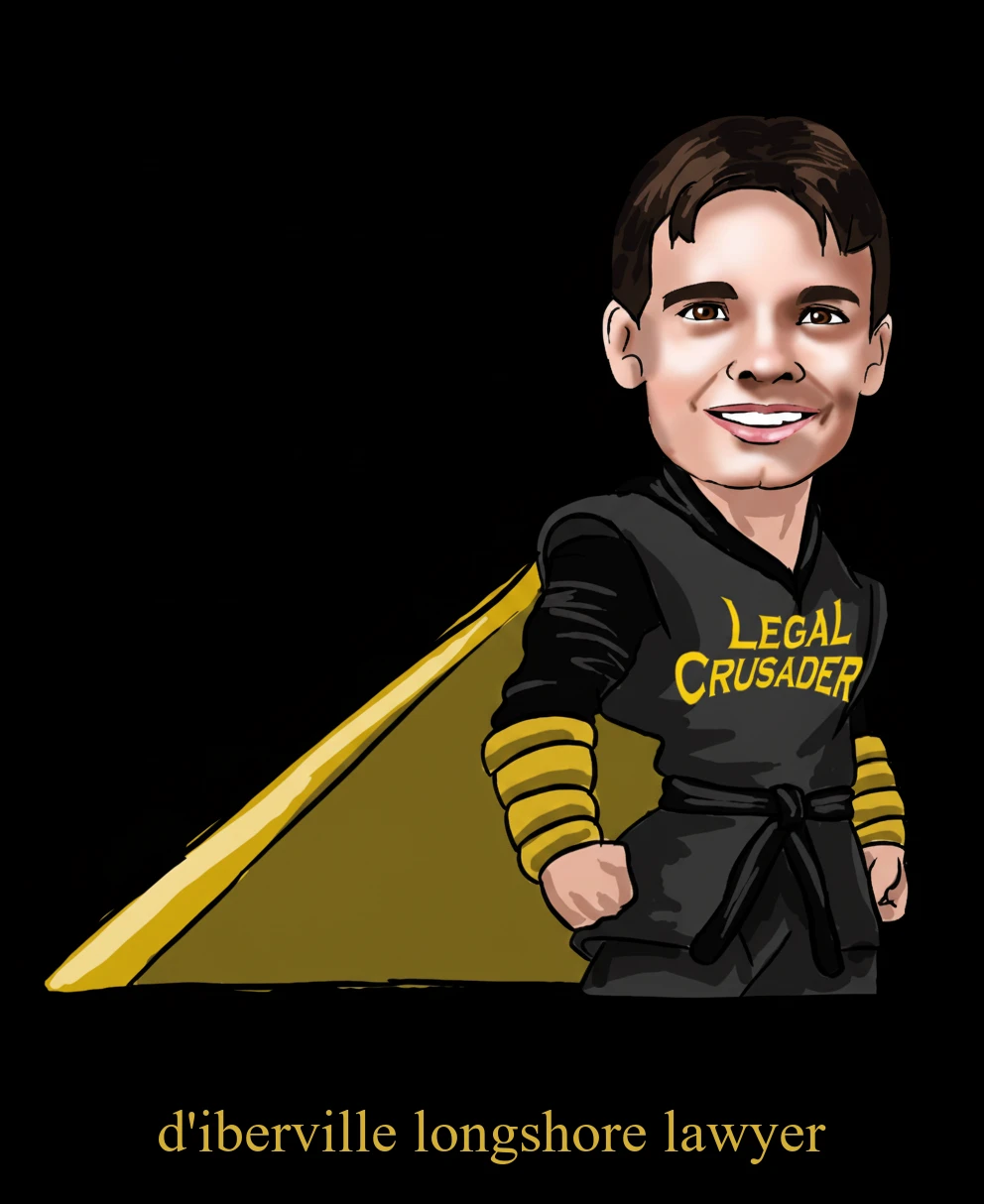
I am Jay Foster. The Legal Crusader. Decades ago I started practicing law on the Mississippi Gulf Coast, and I am still here. I know the federal longshore system. I know the U.S. Department of Labor’s Office of Workers Compensation Programs Longshore division. The Administrative Law Judges who decide Mississippi longshore claims out of the New Orleans district are people I know. The carrier’s lawyers know those judges too. They appear in front of them regularly. When you need someone in that room who knows how to fight, you need me.
Mississippi has exactly one lawyer whose contract GUARANTEES, ahead of any work, that you walk off with more in your pocket than he does, and that lawyer is me. I do it on every D’Iberville longshore claim. Every case. No exceptions.
The LHWCA is a federal statute. It operates outside Mississippi workers’ compensation entirely. The deadlines, the benefit formulas, the hearing procedures, the appeal process to the Benefits Review Board, all of it is federal. A lawyer who handles car wrecks and dabbles in longshore is not enough. A case manager who has never read the Act is not enough. You need a lawyer who has been in this system long enough to know how the carrier thinks and how to counter it at every step.
You can verify any Mississippi lawyer’s Bar license status in sixty seconds at the Mississippi Bar’s public search. The TV lawyer advertising on Harrison County television does not have a Mississippi Bar license. He cannot appear in any court or hearing room in this state on your behalf. When the carrier refuses to pay, he has to find someone else to do the actual work. That someone else does not know your case the way it needs to be known.
Every D’Iberville Longshore Lawyer Claim I Handle For You
Shipyard injuries at Gulf Ship, Bollinger Gulfport, and Gulf Coast Shipyard Group. D’Iberville workers commuting to the Gulfport shipyards face the full range of shipbuilding hazards: structural steel, welding, overhead crane operations, confined spaces, and vessel launch work. Gulf Ship is a 38-acre facility on Seaway Road that builds and maintains tractor tugboats and platform supply vessels for offshore oil operations. Bollinger Gulfport Shipbuilding sits on Bayou Bernard and serves as a major support facility for Bollinger Mississippi Shipbuilding in Pascagoula. Injuries at either facility are covered under the LHWCA.
Injuries at Ingalls and Bollinger Mississippi in Pascagoula. Some D’Iberville workers make the longer drive east to Jackson County. Ingalls Shipbuilding employs more than eleven thousand people and is the largest manufacturing employer in Mississippi. Bollinger Mississippi Shipbuilding handles both defense and commercial construction. Injuries at either facility are federal LHWCA matters regardless of where you live.
Equipment and machinery injuries. Crane failures, forklift accidents, welding equipment malfunctions, and falling objects produce catastrophic injuries in shipyard environments. These claims often involve third-party liability in addition to LHWCA benefits when the equipment manufacturer or another contractor contributed to the injury.
Occupational disease claims. Years of welding fume exposure, industrial noise, and hazardous material contact create cumulative conditions that are fully covered under the LHWCA. Hearing loss claims alone represent a significant category of longshore benefits that carriers routinely undervalue or dispute.
Death claims for surviving families. When a covered worker dies from a work-related injury, the LHWCA provides survivor benefits. These claims require immediate legal action to preserve the family’s rights and must be handled by someone who knows the federal system from the first call forward.
D’Iberville: The City That Grew Fast And Works Hard
D’Iberville is one of the fastest-growing cities in Harrison County. The I-110 spur connects it directly to Biloxi and the Highway 90 corridor. The Promenade at D’Iberville sits off Highway 49, a retail corridor that went up as the residential population expanded. The city incorporated relatively recently and built itself on the workforce that surrounds it. That workforce includes a significant number of shipyard and maritime workers who live in D’Iberville and drive west to Gulfport or east to Pascagoula every shift.
D’Iberville sits on the north shore of Back Bay, directly across from Biloxi. The Back Bay bridge that connects them is the daily commute for hundreds of workers heading to the waterfront and beyond. When one of those workers gets hurt on the job, the claim is a federal matter that most local lawyers have never handled. The carrier knows this. They are counting on it.
The Harrison County Circuit Court is in Gulfport. Harrison County government resources are available through the county’s official site. For the federal longshore system that governs your claim, the governing authority is the U.S. Department of Labor, specifically the Longshore division of the Office of Workers Compensation Programs, the federal office behind that system. For emergency medical care after a workplace injury, Memorial Hospital at Gulfport is the primary trauma facility for Harrison County workers.
A D’Iberville Longshore Lawyer Handles Your File Personally. A Case Manager Isn’t A Lawyer.
The TV lawyer’s office assigns your file to a case manager. She calls you back after the intake. She updates you on the status. She fields your questions. She may sound knowledgeable. She is a secretary with a fancier title. She has no law degree. She has no Bar license. She cannot give you legal advice. She cannot appear in any proceeding. She cannot evaluate what your case is worth. And she is handling forty other files at the same time she is handling yours.
When the carrier’s adjuster calls her with a settlement offer, she passes it to the attorney. The attorney, who may not have reviewed your file in weeks, approves or counters. The entire process is designed to move volume, not to fight for individual workers. You are a file number in a system built for throughput. The carrier is counting on that.
When I take your case, I handle it. You talk to me. Not a case manager. Not an intake coordinator. Me. I know the shipyard. I know the system. I know the judge. And I know what your case is worth.
What The Carrier Does In The First Seventy-Two Hours After Your Injury
The carrier opens a file the moment the incident report hits their system. The adjuster assigned to your claim has handled hundreds of LHWCA cases. He knows the procedural deadlines. He knows the medical offset rules. He knows the scheduled impairment values for every body part under the Act. He is building a case designed to pay you as little as possible while staying within the technical requirements of the law.
He will ask for a recorded statement. The recording is not for your benefit. Every answer you give, about the incident, your pain level, your prior medical history, your ability to work, goes into the file as a potential argument against you. The recorded statement is the first move in a sequence designed to close your file at the lowest number the carrier thinks it can get away with.
He will schedule you with the carrier’s IME doctor. That doctor is not independent. He is paid by the carrier. His reports consistently underestimate injury severity because underestimation serves the carrier’s financial interest. When he says you are at maximum medical improvement and can return to full duty, the carrier uses that report to terminate your wage replacement benefits. Your own physician may have a completely different opinion. The Act has mechanisms for resolving those disputes, but only if your lawyer knows how to use them.
The carrier is also watching your social media from day one. A single photo, check-in, or comment that appears inconsistent with your reported limitations goes directly into their file. Say nothing on social media about your injury, your activities, or your recovery until your case is resolved. And the insurance company laughs at your TV lawyer who is pretending to be a D’Iberville Longshore lawyer and they love it when you hire that guy.
Harrison County Roads And The Rules That Apply To Everyone On Them
Every driver on I-110 through D’Iberville has rules. Speed limits. Merge requirements. No distractions. Those rules protect everyone on the road, including the D’Iberville worker driving to his shift. Shipyard employers have equivalent rules under federal law. OSHA regulations, LHWCA coverage requirements, safety equipment standards, those rules exist because when employers ignore them, workers get hurt and families lose their income.
The federal hearing process and the civil courts exist to enforce those rules when employers and carriers refuse to follow them voluntarily. The carrier’s team is in that room every week. They know the judges. They know the arguments. They know how to win against a lawyer who does not understand the system. Put someone in that room who understands the system better than they do.
Three Mistakes D’Iberville Longshore Workers Make That Destroy Good Claims
First mistake: treating the carrier’s doctor as the final word. The carrier’s IME doctor writes a report. The carrier uses that report to cap your benefits. Your own treating physician may disagree with every word of it. The LHWCA has a formal process for resolving disputes between medical opinions, but you have to know how to invoke it and when. Accepting the carrier’s medical conclusion without challenge is one of the most expensive mistakes a longshore worker can make.
Second mistake: not documenting everything immediately. The incident report matters. The witnesses matter. The condition of the equipment that failed matters. The security footage from the shipyard matters. All of it starts disappearing within days of the injury. Shipyards have internal investigation procedures that serve the employer’s interests, not yours. A preservation demand letter must go out fast. The longer you wait, the more of your case is already gone before any lawyer ever sees the file.
Third mistake: assuming the carrier will treat you fairly. Some adjusters are professional. Some are even personally decent. But every one of them works for the carrier, is evaluated on the carrier’s financial outcomes, and is trained to minimize claim costs. The system is not designed to be fair to you. It is designed to protect the carrier’s exposure. You need someone on your side who understands that and acts accordingly from day one.
The Foster Fair Fee Guarantee: No TV Lawyer Will Ever Match It
Before we start, I guarantee in writing that you will put more money in your pocket than I do. Not after the case closes. Before we begin. In writing. Every client. Every case. No exceptions.
A TV lawyer ran to the Mississippi Bar with a complaint trying to take that guarantee off the public-facing record. The Bar dismissed it. Look at that move on its own terms. The first instinct of the competing firm was not to make the same promise to its own clients. It was not to argue, in writing, that the promise was misleading. It was to ask the regulator to silence the only piece of consumer information on the Mississippi coast that compares fee outcomes between firms in plain English. That is the part of the story the TV lawyer never wanted publicized, and it is the reason the guarantee remains the cleanest test of whose interests a Harrison County longshore lawyer is actually working for.
Read the full Foster Fair Fee Guarantee before you call any lawyer. Then ask the TV lawyer to match it in writing before you sign anything. What you hear next will tell you everything you need to know about who is actually fighting for you.
▼ Get Your FREE Book Right Now ▼
Fill Out The Form Below And I Will Send It Immediately
The $5,000.00 Double Dare For Every TV Lawyer Running Ads In D’Iberville
I will pay you $2,500.00 cash if the TV lawyer whose face is on the billboard personally handles your longshore case from the first call to the final check. Every phone call. Every hearing appearance. Every filing. Personally. I will pay you another $2,500.00 if that same TV lawyer personally argues your case before a federal Administrative Law Judge in the New Orleans district of the U.S. Department of Labor.
Five thousand dollars. Cash. Should the face from the billboard turn out to be the one doing the actual work.
Nobody has ever collected. Nobody ever will.
Frequently Asked Questions From D’Iberville Longshore Workers
I Live In D’Iberville But Work At A Gulfport Shipyard. Which Lawyer Should Handle My Claim?
The LHWCA claim is governed by where the injury occurred and who your employer is, not where you live. If you were injured at Gulf Ship, Bollinger Gulfport, or Gulf Coast Shipyard Group in Gulfport, your claim is a federal LHWCA matter administered through the Department of Labor. Your home city does not change the law that applies. What matters is that your lawyer knows the federal system, knows the Gulfport shipyard environment, and can appear at a DOL hearing when needed. D’Iberville and the Gulfport shipyard corridor are core to my practice area. The lawyer who has never been in that hearing room cannot give you the analysis your specific employer and injury require.
The Carrier Offered Me A Settlement Right Away. Should I Take It?
Do not accept any settlement without having it reviewed by someone who knows what the LHWCA actually requires the carrier to pay. Early settlement offers are almost never full value. The carrier knows more about your case than you do at that point. They know their exposure. They are offering less than that exposure because they can. A quick settlement costs you years of potential benefits, future medical coverage, and permanent impairment payments you may be entitled to under the Act’s scheduled benefit structure. The injured workers who recover what their case is actually worth are the ones who walked away from the early offer and let a lawyer who knows the federal system tell them what the case was worth before they signed anything.
My Employer Says I Was At Fault For The Injury. Does That End My Claim?
No. The LHWCA is a no-fault system. You do not have to prove your employer was negligent to receive LHWCA benefits. The only exceptions are injuries caused by the worker’s own intoxication or intentional self-inflicted harm. An employer claiming you caused your own injury is a tactic, not a legal defense to your basic LHWCA benefit entitlement. Where employer fault or third-party negligence does matter is in any additional claims beyond the LHWCA benefits themselves. That analysis requires someone who knows both the federal system and Mississippi civil litigation.
How Long Do I Have To File My Longshore Claim After The Injury?
You must notify your employer within thirty days of the injury. You have one year from the date of injury to file a formal claim for compensation with the Department of Labor. Missing either deadline can give the carrier a procedural defense that damages or eliminates your recovery. These deadlines run from the date of injury, not from the date you realized how serious the injury was. Workers who wait to see how they feel in a few weeks are workers whose claims start with a procedural problem that should never have existed.
What Is My Longshore Claim Worth?
The base wage replacement under the LHWCA is two-thirds of your average weekly wage, subject to national minimums and maximums. Temporary total disability pays that rate while you are unable to work. Temporary partial disability pays a modified rate if you can work in a reduced capacity. Permanent impairment carries scheduled benefits for specific body parts set by federal statute. Serious injuries that result in permanent total disability or disfigurement carry additional compensation. Medical treatment is covered in full. Vocational rehabilitation is available. What the carrier’s offer is worth compared to all of that is a question a real longshore lawyer can answer at no cost before you decide anything.
What Is The Difference Between The LHWCA And Mississippi Workers’ Compensation?
They are entirely separate systems. Mississippi workers’ compensation is administered by the Mississippi Workers Compensation Commission and covers most land-based workplace injuries in this state. The LHWCA is a federal statute administered by the U.S. Department of Labor that covers maritime workers on navigable waters and adjoining areas. The benefit formulas are different. The deadlines are different. The hearing procedures are different. The appeal process is different. If you file under the wrong system, or if the carrier argues you are not covered by the LHWCA when you are, you need a lawyer who knows both systems well enough to protect your rights under the correct one.
You cross Back Bay every morning to go build something. The carrier is counting on you not knowing what the federal law requires them to pay when you get hurt doing it. They are counting on the lawyer you hire not being able to walk into the hearing room when it matters.
I have been in that hearing room. I have been practicing on this coast for decades. My office is in Ocean Springs, close enough to know every road you drive and every yard you work in. The consultation is free. The insurance company started its clock the day you were injured, and it has not stopped. When you have decided you are done letting it run with no one on your side of the file, my number is 228-872-6000.
Your TV lawyer will not check the average weekly wage math on your longshore claim. Checking costs him minutes he would rather spend closing the next file on his list.
The carrier calculates your rate off your lowest earning weeks whenever it can get away with it. Nobody fielding your calls at a referral firm is going to catch that, because catching it does not close the file any faster.
I check the math on every average weekly wage calculation before accepting it, because a few dollars shaved off your weekly rate adds up to real money over months of disability.
A claim denied as federal when it should be state, or state when it should be federal, gets resolved by someone who has actually sat in a federal longshore hearing room. Your TV lawyer has not. He never will.
Your TV lawyer has never sat in a federal longshore hearing room in his life. He will tell you he handles these claims. He will not tell you he has never argued one.
The carrier counts on you giving up before a hearing ever gets scheduled. That silence is a strategy, not an accident, and it works on anyone who does not know to push back against it.
I have sat in that hearing room and know exactly how that fight gets won, because I have already won it for workers along Back Bay before you.
P.S. The Foster Fair Fee Guarantee is in writing before we start. Read it here and then ask the TV lawyer to match it. The answer you get will tell you exactly who is fighting for you.
P.P.S. If the injury happened at a Gulfport shipyard, see the Gulfport longshore lawyer page. If the injury happened at Ingalls or Bollinger in Pascagoula, see the Pascagoula longshore lawyer page.
▼ Get Your FREE Book Right Now ▼
Fill Out The Form Below And I Will Send It Immediately