Biloxi: 228-435-3000 | Ocean Springs: 228-872-6000 | Hattiesburg: 601-583-5000
Gautier Longshore Lawyer: This City Was Built By Shipyard Workers And They Deserve A Lawyer Who Will Actually Fight The Carrier
Gautier was built by shipyard workers. That is not a figure of speech. During World War II, men came from across the region to work at Ingalls in Pascagoula, and they settled in Gautier because it was close to the yard and far enough from everything else to be home. When Litton Industries bought and expanded Ingalls in the 1960s, Gautier grew again. The city that incorporated in 1986 was already decades old in spirit because the workers who built it had been there since the war. If you live in Gautier and you work at Ingalls, or Bollinger Mississippi Shipbuilding, or VT Halter Marine, you are living in a city your trade built. A Gautier Longshore Lawyer should understand that this city’s history is a shipyard history, because the claim rests on that work.
And when you get hurt at that shipyard, the carrier opens a file on you before you have finished filling out the incident report. The adjuster assigned to your claim handles LHWCA cases every week. He knows the federal system. He knows the Administrative Law Judges in the New Orleans district who hear Mississippi longshore matters. He knows what your case is worth to the carrier, and he is working to pay you less than that from the first phone call. The TV lawyer running ads on Highway 90 through Gautier has never walked into that hearing room. He does not have a Mississippi Bar license. He cannot represent you in any Mississippi proceeding, state or federal. He took your call, gave you a case number, and handed your file to a case manager who has never been through the Ingalls gate.
That case manager is not your lawyer. And right now, the carrier’s team is already three steps ahead of her.
Why Gautier Shipyard Workers Need A Gautier Longshore Lawyer Who Can Actually Enter The Fight
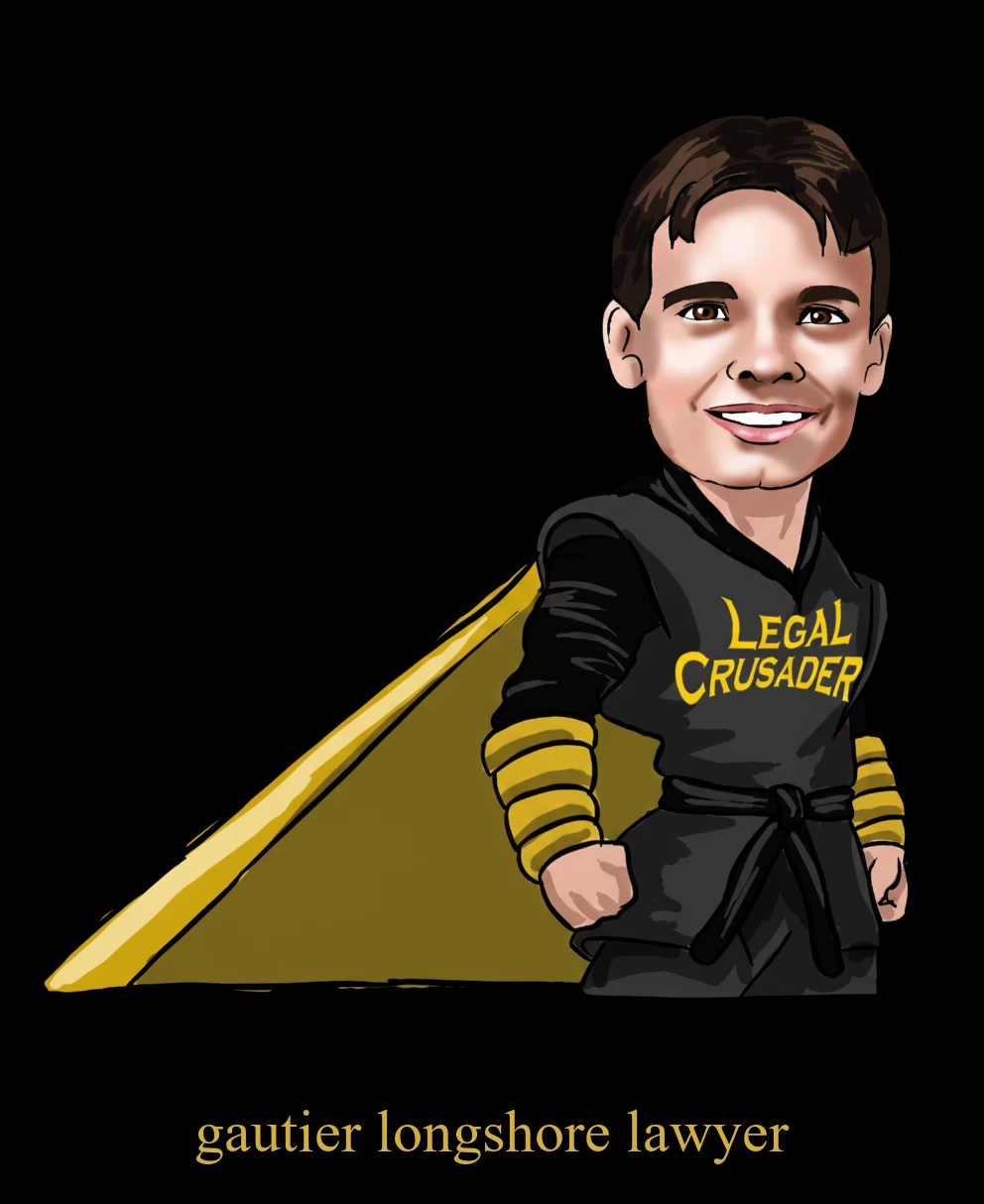
I am Jay Foster. The Legal Crusader. I have practiced law on the Mississippi Gulf Coast for decades. The federal longshore system is something I know inside and out. I know the U.S. Department of Labor, the Office of Workers Compensation Programs, and its Longshore division inside and out. I know the hearing procedures, the benefit formulas, the appeal process to the Benefits Review Board, and the arguments the carrier’s lawyers make in front of federal Administrative Law Judges in the New Orleans district. I know them because I have been there.
Here is where I stand alone in Mississippi. Before we start, my written promise GUARANTEES that you pocket more money than I do, and no other lawyer in the state will sign that. Every case. No exceptions.
The LHWCA is federal law. It does not operate through the Mississippi Workers Compensation Commission. It has its own deadlines, its own benefit calculations, its own hearing structure, and its own appeal track. A lawyer who handles car wrecks on Highway 90 and picks up the occasional maritime case is not the same as a lawyer who has spent decades in the federal system. The carrier’s team knows the difference. They are counting on yours not.
You can check the lawyer’s Mississippi standing with the Bar through the Bar’s public records tool before you trust anyone with your case. The TV lawyer whose billboard you passed on your way into work is not licensed in Mississippi. He cannot walk into Jackson County Circuit Court. He certainly cannot stand in front of a federal ALJ in the New Orleans district on your behalf. When the carrier disputes your claim, he has to find someone local to do the actual fighting. That someone does not know your case the way it needs to be known.
Every Case A Gautier Longshore Lawyer Handles For Workers In This City
Ingalls Shipbuilding injuries. Huntington Ingalls Industries employs more than eleven thousand people in Pascagoula, making it the largest manufacturing employer in Mississippi. The yard builds destroyers, amphibious assault ships, and Coast Guard cutters. Gautier workers have been driving to Ingalls since the 1940s. Crush injuries, welding burns, overhead crane accidents, fall injuries, and confined-space incidents at Ingalls are all covered LHWCA matters.
Bollinger Mississippi Shipbuilding injuries. Bollinger’s Pascagoula facility handles both defense and commercial construction and sits on Bayou Casotte. Workers injured there face the same federal longshore system as Ingalls workers. The carrier defending a Bollinger LHWCA claim is just as prepared as the one defending an Ingalls claim. Your lawyer needs to be equally prepared.
VT Halter Marine injuries. Halter Marine operates facilities in the Pascagoula and Moss Point area and has built more than three thousand vessels over sixty years of operation, delivering to twenty-nine countries. Gautier workers at Halter Marine are covered under the LHWCA for qualifying maritime work on navigable waters and adjoining areas.
Equipment and machinery failures. Shipyard environments involve some of the most dangerous equipment in any American workplace. Overhead crane failures, forklift accidents, scaffolding collapses, and welding equipment malfunctions produce catastrophic injuries. Many of these cases involve third-party liability beyond LHWCA benefits when the equipment manufacturer or another contractor contributed to the cause.
Occupational disease and hearing loss. Decades of working in a shipyard environment expose workers to industrial noise, toxic welding fumes, asbestos in older vessels, and hazardous chemicals. The LHWCA covers occupational diseases and conditions that develop over time from employment exposure. Hearing loss claims in particular are frequently undervalued by carriers and require careful documentation to recover full benefits.
Survivor benefits. When a covered Gautier worker dies from a qualifying workplace injury, the LHWCA provides benefits to surviving spouses and dependents. These claims must be pursued quickly and correctly from the moment of loss.
A City Built On The Water And The Work
The Pascagoula River runs along the eastern border of Gautier. Locals call it the Singing River, named for the haunting sound heard over the water in late summer and autumn evenings, a sound tied to the legend of the Pascagoula tribe who walked into the river rather than face conquest. The river that borders Gautier has its own history, its own voice, and its own connection to the men who have worked the water and the yards beside it for generations.
Gautier’s own history is part of that story. The Gautier family established their sawmill on the west bank of the Pascagoula River in 1867. The town that grew around that mill was small until the war came and the shipyard needed workers. Those workers settled here, raised families here, and their children went back to the same yards. The tradition of maritime labor in this community is not abstract. It is generational.
My own family has a connection to this history that I will carry the rest of my life. My stepfather served aboard the USS Farragut, DD-348, the lead destroyer of her class. She was moored at buoy X-14 in East Loch at Pearl Harbor on the morning of December 7, 1941. When the attack began at 0758, she went to general quarters and opened fire at 0812. She cleared the nest at 0852 under fire and fought her way down the channel. A Japanese aircraft strafed her at 0921 as she passed Hickam Field. She survived. She went on to earn fourteen battle stars in the Pacific, from the Coral Sea to Okinawa. The men on that ship were not different from the men who drove to Ingalls every morning. They were from this coast. They knew what it meant to show up and do the work regardless of what was coming at them.
When a Gautier shipyard worker gets hurt and the carrier comes at him with a team of lawyers and a system designed to minimize what he collects, I take that personally. The people who built this city and who keep building things for this country deserve a fighter in their corner who will not fold when the carrier pushes back.
The Jackson County Circuit Court serves Gautier. Jackson County government resources are available through the county’s official site. The federal longshore system that governs your claim is administered by the agency inside the Department of Labor that handles Longshore claims. For emergency medical care, Singing River Health System serves Jackson County maritime workers throughout the region.
What The TV Lawyer Does Not Tell You Before You Sign
He does not tell you that the case manager handling your file is a secretary with a fancier title. No law degree. No Bar license. No authority to evaluate what your case is worth or to appear in any proceeding anywhere. She is processing your file the way a clerk processes paperwork. She is not fighting for you. She is moving the case toward a resolution that works for the firm’s volume model.
He does not tell you that the carrier’s doctor is not your doctor. The IME, Independent Medical Examination, is the carrier’s tool. That doctor has a business relationship with the carrier. His reports favor the carrier’s financial interest. When he says you have reached maximum medical improvement and can return to full duty, the carrier uses that opinion to terminate your wage replacement benefits, often before you are actually able to perform your job. Your own physician’s opinion matters, but only if your lawyer knows how to present and protect it in the formal dispute process.
He does not tell you that he cannot go to the hearing. He has no Mississippi Bar license. He cannot appear in the New Orleans district before a federal ALJ. He cannot try your case if the carrier refuses to pay. When the carrier’s lawyers are standing in that hearing room ready to argue, the face on the TV lawyer’s billboard is somewhere else. Your case is in the hands of whoever he was able to find locally at the last minute, and that person is meeting the judge for the first time on the day that matters most.
Think about it this way. You would not hire a Louisiana licensed electrician to rewire a Gautier home that needs to pass a Mississippi inspection. The license that matters is the one that lets you do the actual work in the actual place. The license the TV lawyer has is for somewhere else entirely.
Jackson County Rules Apply To Everyone Including The Carrier
Every driver on Highway 90 through Gautier has rules to follow. Stop signs are not optional. Speed limits apply whether the driver is late for a shift or not. Those rules exist because the alternative is someone getting hurt. Shipyard employers have equivalent obligations under federal law. OSHA safety standards. LHWCA coverage requirements. Incident reporting obligations. Equipment maintenance duties. When an employer cuts corners on those obligations and a worker gets hurt, the federal hearing system exists to hold the carrier accountable.
The civil courts and the DOL hearing rooms are the last line of defense for workers whose employers and carriers decided the rules did not apply to them. The carrier sends lawyers to those rooms who know every procedural argument in the book. Send someone who knows the same arguments and more.
What The Carrier Does While You Are Still In The Emergency Room
The carrier assigns an adjuster to your file before you have been discharged. He requests a recorded statement. He sounds helpful. He says he wants to understand what happened. Every word you say in that statement can be used against you at a federal hearing. Descriptions of your pain level, your version of the incident, your comments about prior injuries or prior medical treatment, all of it goes into the file as potential arguments that reduce what they owe you.
That recorded statement opens a chain of moves built to shut your file for the lowest figure the insurance company thinks it can force on you. You are not required to participate in that sequence. Most workers do because no one ever told them otherwise.
The carrier schedules you with their IME doctor as soon as you are medically stable. That doctor has performed examinations for the carrier on a regular basis. He understands exactly what the carrier expects his report to say. His findings consistently favor the carrier’s financial position. This is not paranoia. It is a documented pattern that every experienced longshore lawyer has seen in case after case. You need someone who knows how to challenge that report and how to protect your own physician’s contradicting opinion.
The carrier also monitors your social media. Activity that appears inconsistent with your reported limitations becomes an argument against you. Stay off social media entirely until your case is resolved.
Three Mistakes Gautier Longshore Workers Make That End Good Claims
First mistake: waiting to call a lawyer because you think the carrier will be fair. The carrier has a team. That team is working your file from the moment the injury is reported. Every day you wait to engage legal representation is a day the carrier is building a case against you with no counterweight. Evidence disappears. Witnesses’ memories fade. Shipyard security footage gets overwritten on short cycles. Preservation demands need to go out immediately. Workers who walk away with what the claim is truly worth had a lawyer on the file from day one, not from month three, after the damage was done.
Second mistake: letting the carrier pick your doctor and accepting that doctor’s opinion as final. You have rights under the LHWCA regarding authorized medical treatment and the process for resolving disputes between medical opinions. Those rights only protect you if your lawyer knows how to invoke them. Accepting the carrier’s IME as the governing medical opinion without challenge can cost you years of wage replacement and permanent impairment benefits.
Third mistake: not understanding the difference between LHWCA benefits and your full recovery potential. LHWCA benefits are no-fault and important. But if a third party, a vessel owner, an equipment manufacturer, another contractor on the site, contributed to your injury, you may have additional claims that significantly increase your total recovery. Most workers never learn this because their case manager does not know it, their TV lawyer has never handled it, and the carrier certainly is not going to tell them.
The Foster Fair Fee Guarantee: One Promise No TV Lawyer Will Ever Make In Writing
Before we start, I guarantee in writing that you will put more money in your pocket than I do. Not after the case. Before we begin. In writing. Every client. Every case. No exceptions.
A TV lawyer filed a Mississippi Bar complaint trying to take that guarantee off the public-facing record. The Bar dismissed it. Picture the meeting where that complaint was drafted. A Mississippi-licensed attorney decided the right professional response to a written promise that injured workers would always come out ahead financially was a regulatory filing aimed at suppressing the promise. Not a counter-offer. Not a competitive guarantee. Suppression. The complaint sits in the public record now as evidence of which side of the worker-versus-carrier line the firm that filed it actually operates on. The Bar’s dismissal answered the legal question. The complaint itself answered a different and more important question about whose interests that firm serves when no one is watching.
Read the full Foster Fair Fee Guarantee before you sign anything with anyone. Then ask the TV lawyer to match it in writing. His answer will tell you everything you need to know.
The $5,000.00 Double Dare For The TV Lawyer Running Ads In Gautier
I will pay you $2,500.00 cash if the TV lawyer whose face is on the billboard personally handles your longshore case from the first call to the final check. Every phone call. Every hearing appearance. Every filing. Personally. Another $2,500.00 goes to you if that same TV lawyer ever personally stands up for your case in a hearing room, facing a federal Administrative Law Judge presiding over the New Orleans district on behalf of the U.S. Department of Labor.
Five thousand dollars. Cash. All of it is yours the moment the face on the billboard does the real work himself.
Nobody has ever collected. Nobody ever will. Because the face on the billboard is not the lawyer doing the work, and never has been.
▼ Get Your FREE Book Right Now ▼
Fill Out The Form Below And I Will Send It Immediately
Frequently Asked Questions From Gautier Longshore Workers
Gautier Has Ingalls Workers In Almost Every Neighborhood. Why Does The Lawyer I Hire Matter So Much?
Because Ingalls LHWCA claims are defended by professional carrier attorneys who handle these cases constantly. They know the Administrative Law Judges. They know the procedural arguments. They know the medical arguments. They know how to turn a disputed claim into an extended, expensive fight that discourages workers from pursuing what they are owed. The lawyer you hire needs to know all of those same things and be willing to go the distance when the carrier decides to fight. A TV lawyer who cannot appear at a federal hearing is not going that distance with you. A real Mississippi longshore lawyer is.
I Was Hurt At Halter Marine In Moss Point. Do I Have A Longshore Claim?
VT Halter Marine’s operations are classic LHWCA covered employment for workers engaged in shipbuilding, repair, and maritime vessel construction on navigable waters and adjoining areas. If your injury occurred at a covered Halter Marine situs while you were performing covered work, you likely have a LHWCA claim. The specific facts of your employment relationship, the nature of your duties, and where the injury occurred all matter to the coverage analysis. Do not let the carrier make that determination for you. The injured worker who never asks the question is the one who gets the answer the carrier picked.
How Is My Longshore Wage Replacement Calculated?
Your LHWCA wage replacement is two-thirds of your average weekly wage at the time of injury. The average weekly wage is calculated using your earnings over a defined period before the injury. Federal minimums and maximums apply, both updated annually and tied to the national average weekly wage. If you were earning overtime regularly, that earnings history factors into your AWW calculation. If you were working multiple jobs in covered maritime employment, those wages may also be considered. The carrier will calculate the number in whatever way minimizes their obligation. Your lawyer should calculate it in the way that maximizes what the law actually requires them to pay.
The Singing River Legend And What It Has To Do With My Longshore Case
It means the people who lived beside this river understood that some things are worth fighting for and that surrendering to a more powerful force is not the only option. The carrier is more powerful than an individual worker trying to navigate a federal claims process alone. An experienced Mississippi longshore lawyer is the equalizer. The fight is winnable when both sides have professional representation in the federal hearing room. The TV lawyer’s case manager is not professional representation.
Can I Keep Seeing My Own Doctor While My LHWCA Claim Is Active?
Yes. You have the right to treatment from your own physician alongside whatever the carrier authorizes. The dispute process under the LHWCA allows your treating physician’s opinions to be presented and weighed against the carrier’s IME findings. Protecting that right requires knowing how the Act’s medical authorization rules work and when to invoke them. The medical side of a longshore claim is not something to navigate without legal representation. The carrier’s first move on the medical record sets the floor for everything that follows, including the value of the case.
What Happens If I Miss The One-Year Filing Deadline?
Missing the one-year deadline to file a formal compensation order request with the Department of Labor can give the carrier a procedural defense that seriously damages your claim. There are exceptions in some circumstances, but they are narrow and fact-specific. Deadline arguments are among the carrier’s favorite tools because they are cheap to raise and potentially case-ending. The injured workers whose claims are still alive at year three are the ones who hired counsel in the first month, not the eleventh.
The Takeaway: This City Was Built By People Who Showed Up And Did The Work
Gautier was built by the men who drove to Ingalls every morning and came home to a city that grew because they showed up. That tradition is still here. The workers on the Pascagoula waterfront today are part of the same story. When one of them gets hurt and the carrier comes with a team of lawyers and a system built to minimize the payout, they deserve a lawyer who will step into that system and fight.
I have been fighting on this coast for decades. My office is in Ocean Springs, fifteen minutes from Gautier on Highway 90. I know Jackson County. I know the yards. The federal longshore system is something I know inside and out. And I know what a family loses when the carrier succeeds in paying less than what the law requires.
The consultation is free. The carrier’s file on you has been open since the day of the injury. Had enough of watching them run that file with nobody standing on your side of the table? Pick up the phone and dial me at 228-872-6000.
P.S. The Foster Fair Fee Guarantee is in writing before we start. Read it here and then ask the TV lawyer to match it. That answer will tell you more about who is actually going to fight for you than anything else I could say.
P.P.S. If the injury happened at Ingalls or Bollinger in Pascagoula, see the Pascagoula longshore lawyer page. Moss Point and Hurley workers can also start there. If the injury happened at a Gulfport facility, see the Gulfport longshore lawyer page.
▼ Get Your FREE Book Right Now ▼
Fill Out The Form Below And I Will Send It Immediately