Biloxi: 228-435-3000 | Ocean Springs: 228-872-6000 | Hattiesburg: 601-583-5000
Moss Point Longshore Lawyer: The Shipyard Built This City And The TV Lawyer Has Never Set Foot In The Hearing Room Where Your Future Gets Decided
You are reading this on a phone or a screen somewhere near the Pascagoula River. Maybe you are at home in Moss Point, or sitting in a waiting room after the injury, or lying awake at 3 a.m. running the math on what happens next. Here is what is happening on the other side right now, whether you know it or not. A Moss Point Longshore Lawyer knows the Pascagoula River yards and the federal system covering the people who work them.
The carrier assigned an adjuster to your file before you finished filling out the incident report at the yard. That adjuster has handled LHWCA claims for years. He knows the federal system. New Orleans has its own bench of Administrative Law Judges for Mississippi longshore cases, and he has appeared in front of them before. He knows the medical doctors whose reports consistently produce findings that minimize carrier exposure. And he is building a file designed to pay you as little as the law will allow while you are still trying to figure out who to call.
The TV lawyer’s number is on a billboard on Highway 63. You may have already called it. What answered was a call center. What was assigned to your file is a case manager, a secretary with a different business card and no law degree, no Bar license, no standing to appear in any proceeding, and no experience inside the federal longshore system that is about to determine your financial future. The carrier knows this. They pulled the settlement history on that firm before they made their first offer. That offer reflects precisely what they know your lawyer can and cannot do.
What they cannot do is walk into a federal ALJ hearing room and make the carrier answer for what they owe you. I can. I have been doing it for decades.
Why A Moss Point Longshore Lawyer Has To Be Able To Enter The Fight, Not Just Advertise In It
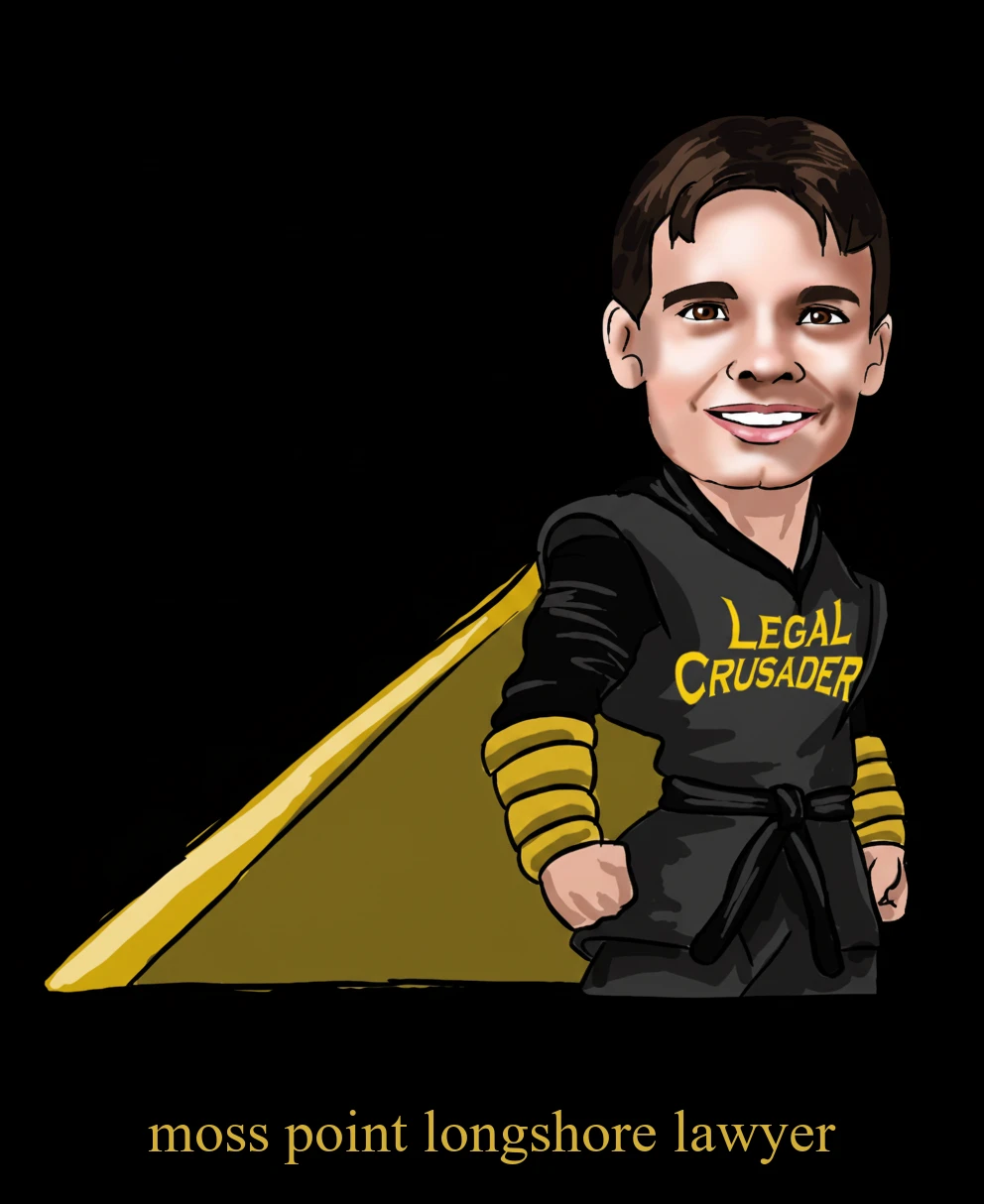
I am Jay Foster. The Legal Crusader. My law practice on the Mississippi Gulf Coast began decades ago and I am still at it. I know the Labor Department’s Longshore office, the federal agency that administers your LHWCA claim, processes your paperwork, and whose Administrative Law Judges decide disputed cases in the New Orleans district. I know those judges. I know the procedures. I know the carrier’s playbook because I have been on the other side of it for three decades.
Ask another lawyer in Mississippi whether his paperwork GUARANTEES, before you hire him, that you take home more money than he does. Only one lawyer says yes, and I am that lawyer. Every case. No exceptions.
You can verify any Mississippi lawyer’s Bar license status in sixty seconds at the Mississippi Bar’s public search. The TV lawyer whose face is on the billboard on Highway 63 is not licensed in Mississippi. He cannot walk into Jackson County Circuit Court. He certainly cannot stand in front of a federal ALJ in the New Orleans district on your behalf. When the carrier disputes your claim and it goes to hearing, he has to find someone local to do the actual work. That someone is meeting the judge for the first time on the day that matters most to you.
Every Case A Moss Point Longshore Lawyer Takes On For Workers Here
Bollinger Mississippi Shipbuilding injuries. Bollinger acquired the former Halter Marine Pascagoula operations in November 2022, and the consolidated facility on Bayou Casotte handles both defense and commercial vessel construction. Many Moss Point workers commute to Pascagoula for these shifts. Injuries at that shipyard, structural steel, overhead crane operations, welding, pipefitting, confined-space work, are covered LHWCA matters.
Knights Marine and Industrial Services. Knights Marine operates at 2900 Colmer Road in Moss Point and provides marine industrial services in the Jackson County area. Workers injured at covered maritime worksites in connection with these operations may have LHWCA coverage depending on the specific facts of their employment and the situs of injury.
Ingalls Shipbuilding injuries. Moss Point residents have driven to Ingalls Shipbuilding in Pascagoula since Ingalls expanded after World War II and drew workers from across Jackson County. If you live in Moss Point and work at Ingalls, your LHWCA claim is a federal matter. Your home address does not change the law that governs what the carrier owes you.
River and waterfront injuries. Moss Point sits at the confluence of the Pascagoula River and the Escatawpa River. Workers injured loading, unloading, or working on vessels or adjoining waterfront areas along those rivers may have LHWCA coverage. The situs and status analysis matters and the carrier will conduct it in their favor if you let them.
Occupational disease and hearing loss. Decades of shipyard noise, welding fume exposure, and hazardous material contact produce cumulative conditions the LHWCA covers. These claims have tight documentation requirements and carriers routinely undervalue them. Early legal involvement protects your right to maximum benefits.
Death claims. When a covered Moss Point worker dies from a qualifying work injury, the LHWCA provides survivor benefits to spouses and dependents. These claims require immediate action.
The City The Pascagoula River Built
Moss Point is the only city on the Mississippi Gulf Coast with a riverfront. The Pascagoula River and the Escatawpa River meet here, and that confluence has defined this city since before it had a name. By the early 1900s, Moss Point was the world’s largest exporter of longleaf yellow pine lumber, shipping timber to Europe and Mexico on shallow-draft schooners built and repaired along these same banks. The city incorporated in 1901 as the only municipality in Mississippi to skip village and town status entirely, jumping directly to city because the population driven by the sawmill industry had already crossed 3,000 residents.
The lumber era gave way to the shipbuilding era. When Ingalls expanded in Pascagoula after World War II and again when the yard grew in the 1960s, the workers who came to build ships for the U.S. Navy settled in Moss Point. The same pattern that shaped Gautier shaped this city. The yards in Pascagoula are the economic engine and Moss Point is where the workforce lives. The Halter Marine facility in Moss Point, which built U.S. Navy oceanographic survey ships including the T-AGS class under federal contracts through the 1990s and into the 2000s, brought that shipbuilding tradition directly to Moss Point soil before those operations consolidated into the Pascagoula yards under Bollinger.
The Moss Point Historic District is listed on the National Register of Historic Places. More than a hundred century-old homes stand in that district, built by the families who ran the mills and the yards. The city that those families built deserves a lawyer who will fight the federal longshore carrier with the same commitment that built it.
For area resources: Jackson County government and circuit court information is available through the county’s official site. Singing River Health System serves Jackson County maritime workers for emergency and ongoing medical care.
What The TV Lawyer Is Not Telling You Before You Sign
He is not telling you that the case manager handling your file is a secretary with a fancier title. No law degree. No Bar license. No authority to evaluate your LHWCA claim, appear in any proceeding, or tell you what two-thirds of your average weekly wage actually calculates to under the federal formula. She is processing your file the way a data entry clerk processes a form. The carrier’s adjuster is processing your file the way someone who handles these cases for a living processes a claim designed to minimize exposure.
He is not telling you that the carrier’s IME doctor works for the carrier. The letters stand for Independent Medical Examination. The word independent is the most dishonest word in the carrier’s vocabulary. That doctor is paid by the carrier on a recurring basis. His reports favor the carrier’s financial position. When he says you are at maximum medical improvement and ready to return to full duty, the carrier uses that report to stop your wage replacement benefits. Your own physician may disagree with every word of it. Protecting your physician’s contradicting opinion in the formal dispute process requires knowing how the LHWCA resolves those conflicts, and doing so at the right time.
He is not telling you he cannot go to the hearing. When the carrier refuses to pay and your case goes to a federal ALJ, the TV lawyer is not in the room. The face on the billboard is somewhere else. Your case is being argued by whoever he found locally to cover it, and that person is walking in cold on the day that determines your financial future.
Think about it this way. The Halter Marine facility that once operated in Moss Point built oceanographic survey ships under contract to the U.S. Navy, complex vessels requiring precision engineering and qualified specialists. The Navy did not accept a substitute who had never built that class of ship. Your LHWCA claim requires the same standard. Do not accept a substitute lawyer who has never been inside a federal longshore hearing room.
Every Rule On That Yard Exists Because Someone Got Hurt When It Was Ignored
OSHA regulations. LHWCA coverage requirements. Safety equipment standards. Confined-space entry protocols. Every rule on every shipyard in Jackson County exists because at some point the absence of that rule produced an injury or a death. The rules are the minimum. When employers cut corners below the minimum, and they do, and when carriers dispute claims that the law requires them to pay, and they do, the federal hearing system exists to make them answer for it.
The carrier sends experienced longshore attorneys to those hearings. They know the judges. They know the procedural arguments. They know which medical opinions carry weight and which ones can be challenged. The TV lawyer’s case manager sends demand letters and waits for phone calls. Those are not equivalent. The gap between them is the gap between what the carrier offers and what the law actually requires them to pay.
What The Carrier Does The Moment Your Injury Is Reported
The adjuster opens a file. He requests a recorded statement, not for your benefit, but to lock in answers about the incident, your pain levels, your prior medical history, and your ability to work before you have legal advice. Every word of that statement goes into the file as potential argument against you at a hearing.
Think of that recorded statement as the opening step in a plan to settle your file for the smallest sum the carrier can get away with. You are not required to participate in that sequence. Most go along with it simply because nobody told them they could say no.
The carrier schedules an IME. The doctor performing it has a business relationship with the carrier. His report will minimize your injury, accelerate your return-to-work date, and provide the carrier with a medical opinion they can use to cap their exposure. Your own treating physician may completely disagree. The dispute process under the LHWCA has specific procedures for resolving conflicting medical opinions, procedures that only protect you if your lawyer invokes them correctly and at the right time.
The carrier also monitors your social media. Anything that appears inconsistent with your reported limitations becomes an argument against your claim. Go dark on social media until your case is resolved.
Three Mistakes Moss Point Longshore Workers Make That Cannot Be Undone
First mistake: accepting the carrier’s early settlement offer without knowing what the law actually requires them to pay. The first offer is calibrated to the minimum the carrier believes you will accept given your financial pressure at that moment. The LHWCA sets specific benefit formulas, two-thirds of your average weekly wage, scheduled permanent impairment benefits, full medical coverage. Accepting the early offer before understanding the full scope of what the law requires forfeits benefits you can never recover. The workers who recover what a claim is truly worth are the ones who turned down the quick offer, then had a lawyer steeped in the federal system put a real number on the case before they signed a single page.
Second mistake: waiting weeks to call a lawyer. Evidence disappears. Preservation demands need to go out immediately. Security footage at shipyard facilities overwrites on short cycles. Witness memories fade. The carrier’s file is being built against you from day one. Your file only starts the day a lawyer who knows this system gets engaged. Every day in between is a day the gap widens.
Third mistake: not understanding the difference between LHWCA benefits and any additional claims you may have. The LHWCA is no-fault, you do not have to prove negligence to receive benefits. But if a third party contributed to your injury, a vessel owner who is not your employer, an equipment manufacturer, another contractor on site, you may have additional claims that run alongside your LHWCA benefits and significantly increase your total recovery. Most workers never learn this because their case manager does not know it and their TV lawyer has never handled it.
The Foster Fair Fee Guarantee: The Written Promise No TV Lawyer Will Ever Match
Before we start, I guarantee in writing that you will put more money in your pocket than I do. Not after the case. Before we begin. In writing. Every client. Every case. No exceptions.
A TV lawyer filed a Mississippi Bar complaint against the public publication of that guarantee. The Bar dismissed it. Read what actually happened there. A licensed attorney decided that a written, contractually binding promise to put more money in an injured worker’s pocket than in his own lawyer’s pocket was a problem worth running to the regulator about. Not worth matching. Not worth competing with on terms. Worth filing a complaint to suppress. The Bar saw it for what it was and refused to participate. The complaint, however, lives in the public record now as the cleanest piece of evidence on the Mississippi Gulf Coast about which firm’s business model treats an informed comparison shopper as a threat to be neutralized rather than a customer to be earned.
Read the full Foster Fair Fee Guarantee before you sign anything with anyone. Then ask the TV lawyer to match it in writing. Listen carefully to what he says next.
The $5,000.00 Double Dare For Every TV Lawyer Advertising In Moss Point
I will pay you $2,500.00 cash if the TV lawyer whose face is on the billboard personally handles your longshore case from the first call to the final check. Every phone call. Every hearing appearance. Every filing. Personally. Another $2,500.00 comes out of my pocket if that same TV lawyer personally takes your claim into a hearing room and argues it to a federal Administrative Law Judge handling the New Orleans district for the U.S. Department of Labor.
Five thousand dollars. Cash. If the face on the billboard does the actual work.
Nobody has ever collected.
▼ Get Your FREE Book Right Now ▼
Fill Out The Form Below And I Will Send It Immediately
Frequently Asked Questions From Moss Point Longshore Workers
I Work At Ingalls In Pascagoula But Live In Moss Point. Where Does My Longshore Claim Get Filed?
The LHWCA claim follows the injury and the employer, not your home address. If you were injured at Ingalls Shipbuilding in Pascagoula while performing covered maritime work, your claim is a federal LHWCA matter filed through the Department of Labor. Moss Point is where you live. Pascagoula is where the claim originates. My practice covers both. Your home city does not determine who can represent you or which lawyer knows this system well enough to fight the carrier in a federal hearing room.
The Carrier Said My Injury Is Not Covered Under The LHWCA. Is That True?
Maybe. Maybe not. The carrier will say whatever minimizes their exposure. LHWCA coverage requires satisfying both a status test (the nature of your work) and a situs test (where the injury occurred). Whether you meet both tests is a legal analysis, not a determination the carrier gets to make unilaterally. Carriers routinely deny coverage that clearly existed and use that denial to pressure workers into accepting far less than they were owed. Most workers accept the denial because no one ever told them they had the right to challenge it.
How Long Does A Moss Point Longshore Claim Take?
Uncontested claims where the carrier accepts coverage and pays benefits on time can resolve when your medical treatment is complete and impairment is rated. Disputed claims that go to a federal ALJ hearing take considerably longer, often a year or more from formal filing to decision, with additional time if appealed to the Benefits Review Board. What costs you the most time is delay at the start. Every week without a preservation demand, without documented notice to your employer, and without legal representation is a week the carrier uses to build their defense while yours does not yet exist.
What Is The Difference Between What The Carrier Is Offering And What The Law Requires?
That gap is what this practice exists to close. The LHWCA sets wage replacement as two-thirds of whatever your average weekly wage was, inside federal floors and ceilings updated each year. Permanent impairment carries scheduled benefits for specific body parts under the Act. Serious injuries affecting earning capacity carry additional compensation. Medical treatment is covered in full. Vocational rehabilitation is available. The carrier’s offer is calculated by people whose job is to minimize what they pay. The correct number is calculated by someone who knows what the law actually requires and is willing to go to hearing if the carrier refuses to pay it.
Is There A Time Limit On My Longshore Claim?
Yes, and missing it can be fatal to your case. You must notify your employer of the injury within thirty days. A formal claim for compensation has to be filed with the Department of Labor within one year of the date of injury. Both deadlines matter. Miss either one without proper documentation and the carrier has a procedural argument that can eliminate years of potential benefits. Workers who still have a live claim at year three are the ones who brought in counsel during the first thirty days, and not in the eleventh month.
The TV Lawyer Took My Call. Do I Need A Different Lawyer?
That depends on what happened after the call. If a case manager is handling your file and you have not spoken to a licensed Mississippi attorney since you signed the retainer, you should think carefully about your situation. You are not obligated to stay with any lawyer. You have the right to change representation. The earlier you make that decision, the more of the critical early-stage work can be done correctly. An informed second opinion from a real Mississippi longshore lawyer is the cleanest way to learn what your current representation has actually been doing on your case.
The Takeaway: The Carrier’s File On You Is Already Open
Moss Point was built by people who showed up every day and did work that required skill, precision, and physical courage. The workers who drove to the Halter Marine yard here or to Ingalls in Pascagoula built things that served this country. When the carrier decides to fight a legitimate claim, they are counting on those workers not knowing their rights or not having a lawyer who can enforce them.
I have been enforcing them on this coast for decades. My office is in Ocean Springs, less than twenty miles from Moss Point on Highway 90. The consultation is free. The carrier’s clock has been running since the day of your injury. When you have decided you are done letting them work that file with no one on your side of it, my number is 228-872-6000.
Your TV lawyer signed you up in a five minute call and has not called since. The voice on the phone now belongs to someone who has never passed a bar exam.
Why should the man collecting the biggest check in your case be the one who did the least actual work on it?
I take your call personally, every time, and I never take a dollar off your TTD check. Not one.
Your TV lawyer takes the quick settlement because a fast check keeps his ad budget funded. He has never once walked into a courtroom for a client like you. Insurance adjusters know it, and they price your claim accordingly.
P.S. The Foster Fair Fee Guarantee is in writing before we start. Read it here and then ask the TV lawyer to match it. What he says next tells you everything.
P.P.S. If you work at Ingalls or Bollinger in Pascagoula, see the Pascagoula longshore lawyer page. For the statewide Mississippi overview of LHWCA law, see the Mississippi longshore lawyer page. For Gautier and Jackson County workers, see the Gautier longshore lawyer page.
▼ Get Your FREE Book Right Now ▼
Fill Out The Form Below And I Will Send It Immediately